
Choosing Between ETL and ELT: An Architectural Decision Guide
A deep dive into the architectural tradeoffs between ETL and ELT patterns, and why your choice depends on more than just where transformations happen.
· data-engineering · 3 minutes
Context
Every data pipeline needs to move data from point A to point B, transforming it along the way. The question of where that transformation happens—before or after loading—seems simple, but it has profound implications for cost, flexibility, and operational complexity.
In this post, I walk through the architectural considerations that should drive your ETL vs ELT decision, based on real-world experience building pipelines at scale.
Problem Statement
- Data source characteristics: Multiple upstream systems with varying data quality, schema stability, and update frequencies
- Constraints: Limited budget for infrastructure, small team to maintain pipelines, need to support both analytics and ML use cases
- Success criteria: Data must be queryable within 1 hour of source update, transformations must be auditable, and the system must handle schema evolution gracefully
Architectural Approach
High-Level Architecture
ETL Pattern:Source → Extract → [Transform in Staging] → Load → Destination
ELT Pattern:Source → Extract → Load (Raw) → [Transform in Warehouse] → Curated
Why This Pattern Matters
The transformation location isn’t just a technical detail—it determines:
| Factor | ETL | ELT |
|---|---|---|
| Compute costs | Separate staging infrastructure | Warehouse compute |
| Data lineage | Lost during transform | Preserved in raw layer |
| Flexibility | Fixed transformations | Re-transformable |
| Latency | Higher (transform first) | Lower (load first) |
Alternatives Considered
| Approach | Pros | Cons | When to Choose |
|---|---|---|---|
| Pure ETL | Data minimized before load, PII scrubbed early | Can’t re-transform, requires staging infra | Legacy systems, strict data governance |
| Pure ELT | Full flexibility, audit trail | Higher storage, raw data exposure | Cloud warehouses, evolving requirements |
| Hybrid | Balance of both | More complexity | Most real-world scenarios |
Key Design Decisions
Storage Choice
ELT works when your destination has cheap storage and elastic compute. Cloud data warehouses (Snowflake, BigQuery, Databricks) separate these concerns—storing raw data costs pennies, and you only pay for compute when transforming.
ETL made sense when storage was expensive and warehouse compute was limited. Those constraints rarely apply today.
Schema Evolution
With ELT, schema changes are manageable:
-- Raw data preserves original structureSELECT raw_data:new_field::string AS new_fieldFROM bronze.eventsWHERE _ingested_at > '2024-01-01'With ETL, a new field requires updating the staging transform, testing, and redeploying—before you can even use the data.
Failure Handling
# ELT: Load first, validate laterdef elt_pattern(records: list[dict]) -> None:    # Always land raw data    load_to_bronze(records)
    # Transform with quality checks    try:        transform_to_silver()    except DataQualityError as e:        alert_team(e)        # Raw data still available for debugging
The key insight: with ELT, failures don’t lose data. You can always re-transform.
Tradeoffs & Constraints
What I didn’t optimize for:
- Real-time streaming (batch was sufficient for hourly freshness)
- Absolute minimum storage costs (raw data retention is worth the flexibility)
Why ETL was avoided:
- Separate staging infrastructure adds operational burden
- Transformations become “locked in” and hard to change
- Debugging requires access to source systems (raw data not preserved)
The hidden cost of ETL: When a transformation is wrong, you need to re-extract from source—which may not support historical queries.
What Went Wrong
- Underestimated raw data volume: ELT means storing everything. Had to implement retention policies and lifecycle rules earlier than planned.
- Warehouse compute costs spiked: Naive transformations without proper filtering scanned entire tables. Learned to push down predicates and use incremental models.
- PII in raw layer: Needed to add a pre-load anonymization step for certain fields—a hybrid approach.
Lessons Learned
This project reinforced the importance of:
- Starting with ELT as the default for modern cloud warehouses—it’s more forgiving of changing requirements
- Adding ETL components selectively for data governance (PII), format conversion, or when staging is truly necessary
- Building transformation logic in SQL/dbt rather than Python—lets analysts contribute and reduces operational complexity
- Monitoring warehouse costs from day one—ELT can get expensive without query optimization
How I’d Scale This
At 10× Data Volume
- Implement stricter partitioning on raw tables
- Add incremental processing for all transformation layers
- Introduce caching for frequently-used aggregations
At 100× Data Volume
- Consider streaming ELT for sub-hour freshness
- Implement data tiering (hot/warm/cold) in raw layer
- Add dedicated compute clusters for heavy transform jobs
Cloud Services I’d Introduce
| Current | At Scale |
|---|---|
| Single Snowflake warehouse | Separate warehouses per workload |
| Manual dbt runs | Orchestrated incremental builds |
| Full table scans | Materialized views for hot paths |
Closing
The ETL vs ELT debate is really about flexibility vs control. Modern cloud economics favor ELT—storage is cheap, compute is elastic, and the ability to re-transform historical data is invaluable when requirements change.
But it’s not binary. The best pipelines are hybrid: load raw data for flexibility, but apply targeted transformations early when data governance demands it.
The key insight: choose ELT by default, add ETL components only when you have specific reasons.
Have questions about pipeline architecture? Reach out on LinkedIn or GitHub.
More posts
-
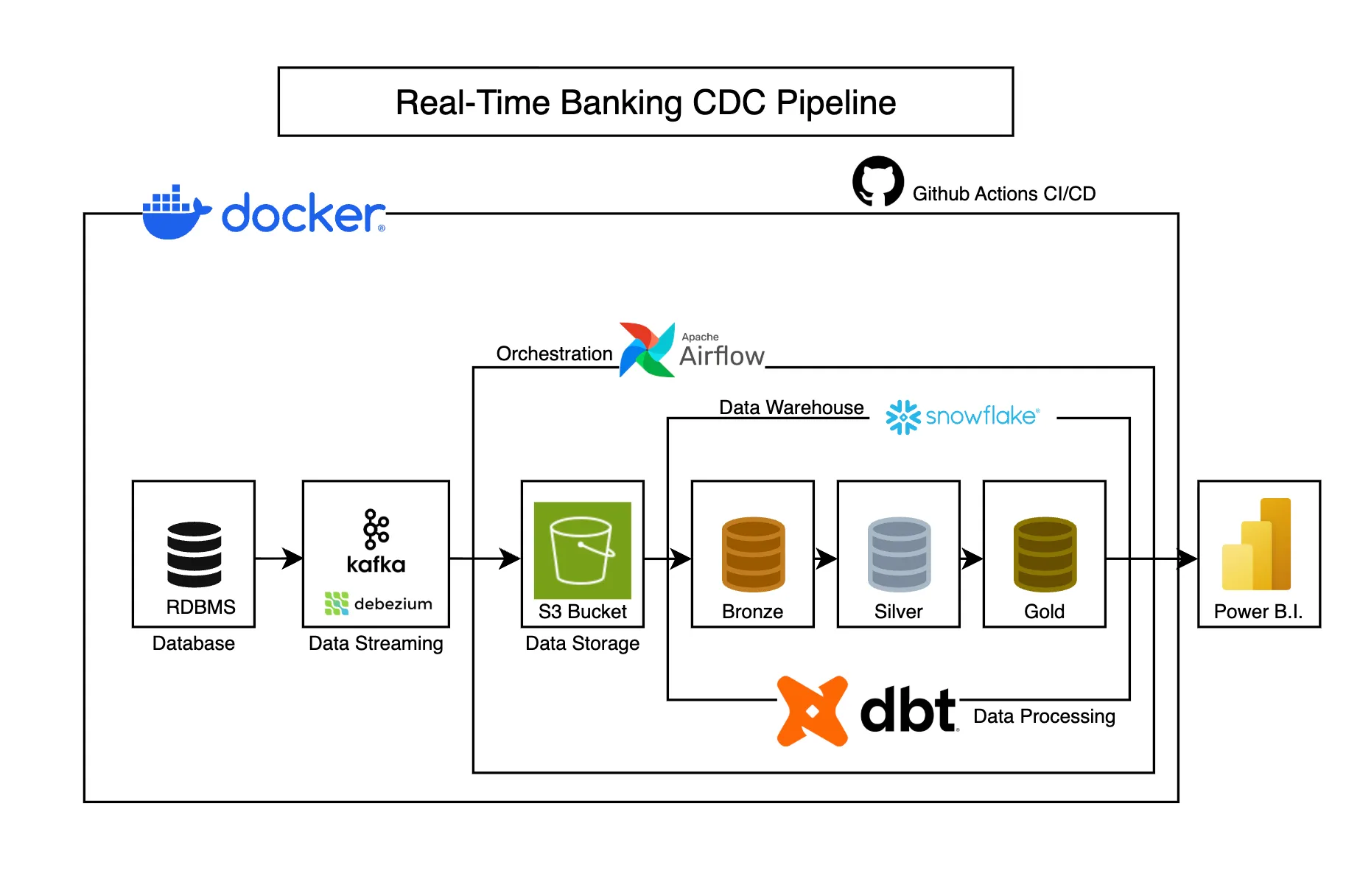
Real-Time Banking CDC Pipeline
Captures banking transaction changes in real-time using CDC, transforming operational data into analytics-ready models for business intelligence.
-
Designing Data Lakehouses with Medallion Architecture
A practical guide to implementing Bronze, Silver, and Gold layers based on lessons from processing 20+ TB of production healthcare data.